

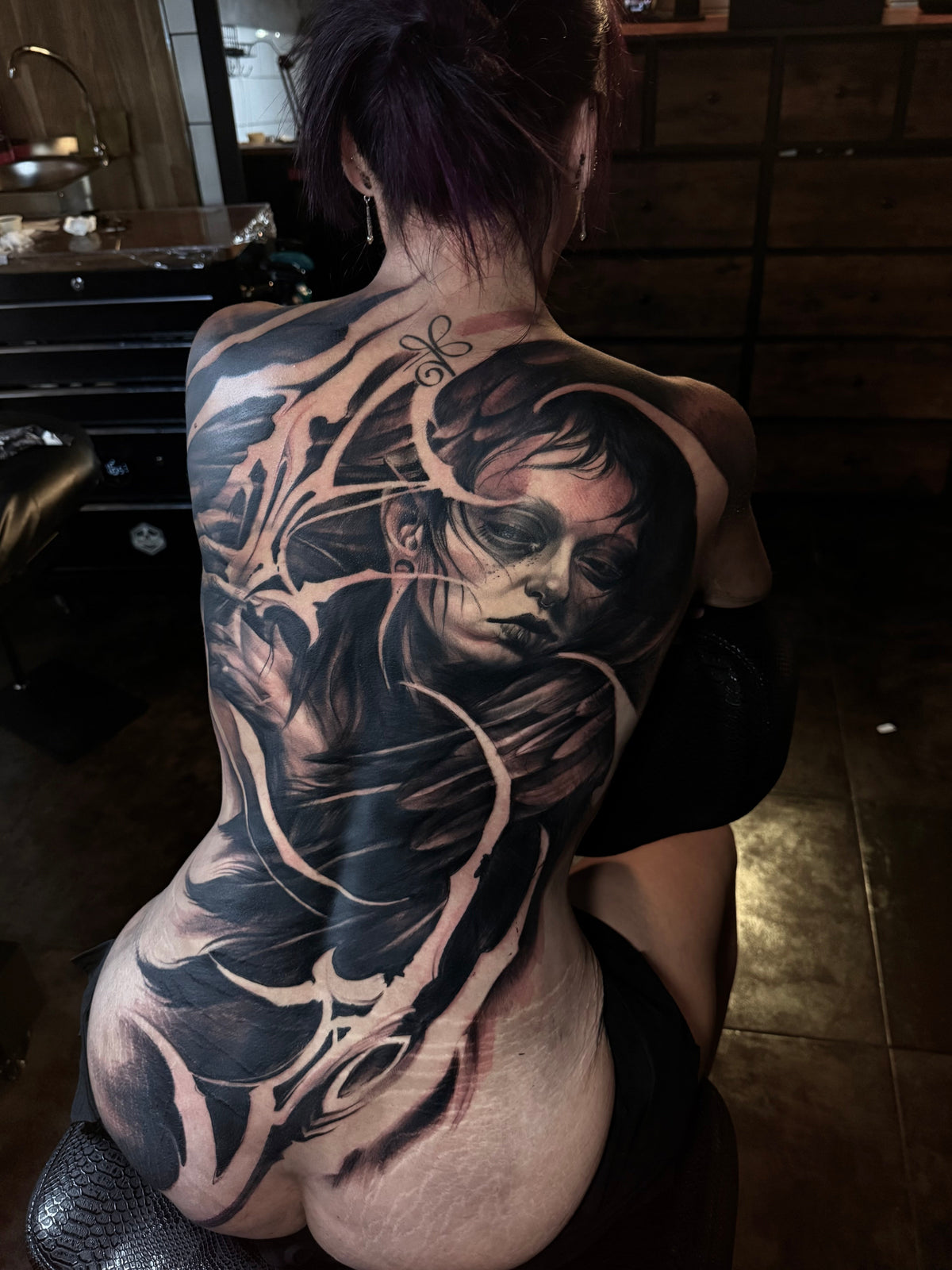
Aser: On Bodysuits, Painting and Blackwork
Aser grew up in a family tattoo studio and began working there at fifteen. In this interview, he discusses the bodysuits that shaped his approach, the influence of painting and natural structures, and what people misunderstand about blackwork.
1. How was it growing up in a tattoo studio?
Growing up in a tattoo studio felt completely normal to me. It was just part of everyday life. For the first four or five years, the studio was actually inside our house. Later it moved to different places. At one point it was even inside second-hand clothing shops. Eventually it became a more conventional tattoo studio.
There were always random people coming and going. Mostly young people. So, as a kid, it was actually quite fun. There was always someone to play PlayStation with. Music playing. Interesting conversations. Lots of stories.
My teenage years were different because that’s when I started working there. From around fifteen, I was basically working full-time all year. I wasn’t just hanging around anymore. I had to deal with clients, draw designs, learn different styles. I taught myself a lot of it by looking at books and references.
The hardest part at first wasn’t tattooing. It was dealing with people. I was very shy with clients during the first year or two. Then I got used to it. After so many years talking to people, even complete strangers started feeling almost like family.
Looking back, I think the most interesting part was being surrounded by so many different people. I also saw how much the psychology around tattooing changed. In the 1990s, people would often arrive genuinely nervous about getting tattooed. Now it’s just much more normal. Tattooing is part of everyday culture.
I didn’t actually decide tattooing was going to be my profession until I was around twenty. Before that, I wasn’t really sure it was what I wanted to do.


2. Do you remember the first tattoo you ever did?
I do. I think it was around 2003 or 2004. I was about fifteen. I tattooed a friend. It was three Gothic letters spelling the name of someone he cared about. Pretty typical for that time, especially around graffiti culture. I used a coil machine.
I remember being quite scared of the responsibility. The machine itself was heavy and intimidating. But the important thing was knowing I was making a permanent mark on someone else’s body. Tattooing wasn’t as normal back then either. So it felt like a pretty big responsibility for a teenager. I think I went over those three letters three times because I wanted them to look right.
The funny thing is, the tattoo is still there. It actually didn’t turn out badly. It looks like a tattoo from that period. Heavier lines. More volume. But it’s still there. I like that. It’s a direct reminder of where I started.
“I started thinking about the body as one complete visual system.”
— Aser


3. What are some of the pieces you are most proud of? And why?
That’s difficult because I’m proud of different pieces for completely different reasons. Some I like because of the design. Some because of the technical side. Others because they changed the way I think about tattooing.
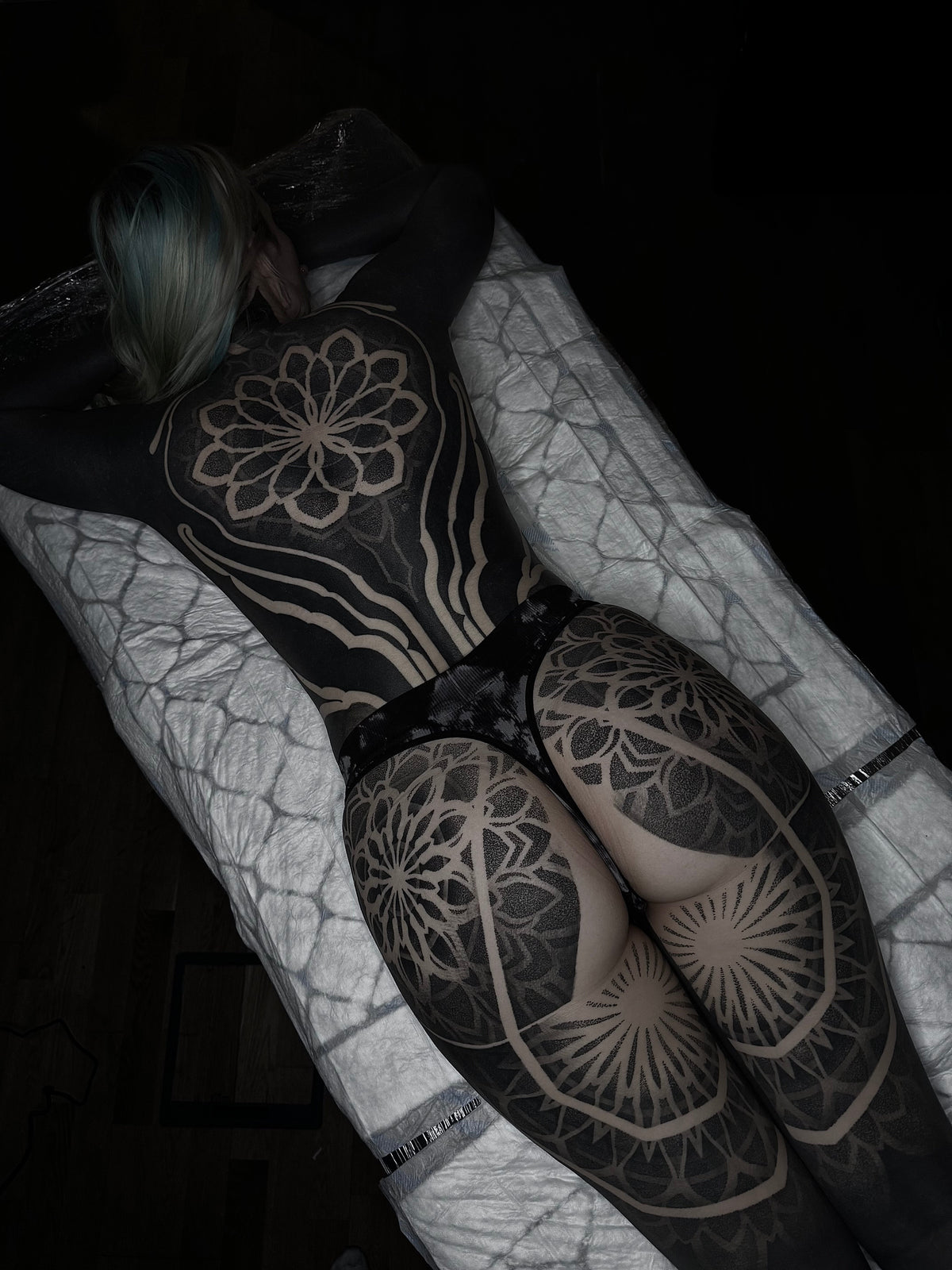
I think some of the big bodysuits I’ve developed with friends over the years are probably the projects I’m most proud of. One of them is a complete white bodysuit I did on a close friend. It became a huge process of experimentation. Blackout. Neo-tribal structures. The relationship between the design and the body.
My own bodysuit is probably the project that taught me the most. I spent three or four years researching all kinds of things. Biology. Anatomy. Natural structures. Mathematics. Skin diseases. Different systems of patterns and forms. I bought loads of books from completely different fields.
I also made thousands of different mock-ups. Hundreds of them by hand. At the beginning I was working on tracing paper because I didn’t have a tablet. Designing my own bodysuit was a big part of that process. Adapting everything to the body, millimetre by millimetre.
Those projects changed the way I see tattooing. I stopped thinking about tattoos as individual images. I started thinking about the body as one complete visual system.


4. Was there a particular artist, artwork, culture or movement that heavily influenced your work?
My influences come from a lot of different places. Not just tattooing. Within tattooing, Little Swastika was one of the artists who impressed me the most when I was younger. Robert Hernández also influenced me at one point, for very different reasons.
But I think my strongest visual influences come from outside tattooing. Urban art. Cinema. Photography. Nature. Comics. When I was a kid, I was really into comics about barbarians, fantasy and Norse mythology. I think a lot of that visual imagination stayed with me.
I’m also really interested in natural structures. Skeletons. Shells. Animals. Marine organisms. The way patterns repeat at different scales. Biology and anatomy probably influenced the way I look at forms more than any single artist.


These days I’m less interested in copying a specific reference. I’m more interested in understanding why something works. Rhythm. Repetition. Proportion. Movement. Symmetry. Texture. Positive and negative space. That’s what interests me now.
“I’m not trying to make a tattoo look like a painting.”
— Aser
5. Has anything from your painting crossed over onto skin yet?
More and more. But not exactly in the way I expected. At first I thought bringing painting into tattooing meant putting specific images onto the skin. A creature. A monster. A certain texture. But slowly I realised it’s not really about transferring the painting. It’s about transferring the structure behind it.
Painting has made me much more aware of natural lines, texture, edges, layers, depth and synthesis. When I work with an airbrush or charcoal, for example, I use different layers and different levels of focus to control where the eye goes.
I’m starting to use the same idea in tattooing. One area can be very focused and detailed. Other areas can become more diffuse, more simplified, almost disappear. A bit like photographic depth of field.
I didn’t really realise how much this was happening until I started painting again. I painted a lot between nineteen and twenty-five while studying Fine Arts. Then I spent almost ten years without painting consistently, apart from the occasional mural or painting.
Now I’m back to it more seriously. And I’m noticing that painting and tattooing are feeding each other. I’m not trying to make a tattoo look like a painting. I’m more interested in taking what I learn from painting and finding a way to make it work on the body.


6. What’s the biggest piece you’ve done in one sitting?
It’s hard to give one answer because it really depends on the style. For me, the size of a tattoo doesn’t necessarily mean it’s a difficult session. You can do a big leg, a full back or a whole arm in one day, depending on the style. If you’re working with a lot of texture or bigger shapes, you can cover a huge amount of skin quite quickly.
Then you have the opposite. If the tattoo needs to be really clean, really precise, more vector-like, it’s completely different. The difficulty isn’t really how much skin you’re covering. It’s how much control you need over every centimetre.
So I’ve never really been that interested in measuring a tattoo just by its size. A huge piece can be quite straightforward. A much smaller one can be a nightmare. For me, it’s much more about the kind of work you’re doing than the amount of skin.

7. How do you get a client through the pain of a heavy session?
The first thing is making sure the person comes in properly prepared. I always tell people to sleep well, get some rest and come in having eaten properly.
I usually like to start early. I also use numbing cream quite a lot. I’ve been using it for years, including on myself. These days I probably use it on around 80% of my clients. I actually prefer working with it.
But you have to know what you’re doing. Different creams work differently. The timing matters. Tattooing numb skin isn’t exactly the same as tattooing normal skin.
I also like working in blocks of time. We might work for an hour, take five minutes, then go again. Halfway through we can take a slightly longer break. But I try not to have really long breaks unless the client needs one.
I think it helps because the person knows what’s happening. They know, okay, we’re going to work for another hour and then we stop for five minutes.
I prefer to work very focused and very calm. I don’t like stopping every five minutes.
After doing this for so many years, you also learn to read the person. Some people want to talk. Some people want music and silence. Some people need more breaks. There isn’t one formula for everyone.
And at some point the body just says, “That’s enough.” When you get there, there’s no point trying to prove anything. You stop.
“But I do think people sometimes confuse a simple-looking tattoo with an easy tattoo.”
— Aser


8. What’s one thing you know now that you wish someone had told you early on?
Probably that when you’re starting out, you can get way too obsessed with small technical things. You forget about things that are much more important. Composition. Anatomy. How the whole thing actually works on the body.
I also wish I’d understood earlier that everyone has their own way of working. Something that works really well for one artist might not work at all for another. You can learn a lot from other people. But at some point you have to find your own way of doing things.
I’ve learned a lot from clients too. With a big project, these days I like to meet the person at least one day before we tattoo. No machine. No tattooing. Just sit down, talk about the project, look at the body, talk about what they want and what I want to do.
I think it matters that the person feels their project is important to you. Even while the cream is taking effect, that can be a good time to talk and get to know the person a bit better.
And probably the other thing I wish someone had told me is that everything has its own timing. When you’re starting out, it’s really easy to get frustrated because you see other people doing things you’re not doing yet. Then you realise maybe you don’t even need those things at that point. Everyone moves at their own speed.

9. What do people often misunderstand about blackwork tattoos?
I think a lot of people see blackwork as something simpler because it’s more black or more graphic. For me, it’s actually the opposite.
When you have fewer elements and less colour, everything you leave in the design becomes more important. The black. The negative space. The shape. The proportions. Everything has more weight.
From the outside, a big black area can look like you’re just filling it in. But there can be a lot of structure and composition behind it. It’s not just putting black there because you can.
That said, I don’t really know what most people think about blackwork. It probably depends a lot on how much they know about tattooing. But I do think people sometimes confuse a simple-looking tattoo with an easy tattoo.

10. Do you think blackwork is becoming too mainstream?
It depends. I think there are a lot of different types of blackwork. Some of them are quite commercial. Some are much harder to understand or even to make.
When something becomes more commercial, there are good and bad sides to it. More people see it. More people get interested in it. I think that’s a good thing.
But I don’t think some types of blackwork are ever going to be completely mainstream. Especially big projects, bodysuits, or really visual work that isn’t very figurative.
There’s just too much commitment involved. Time. Money. A lot of hours. Pain. Recovery. And you also have to really want that kind of tattoo on your body.
So I’m happy that more people are interested in it. I’d rather see that than have it be something only a small group of people know about. But I think there will always be certain types of blackwork that stay pretty niche. Simply because they ask so much from the person wearing them.
Follow Aser on Instagram: @aseralexander


Join the Society


Read more
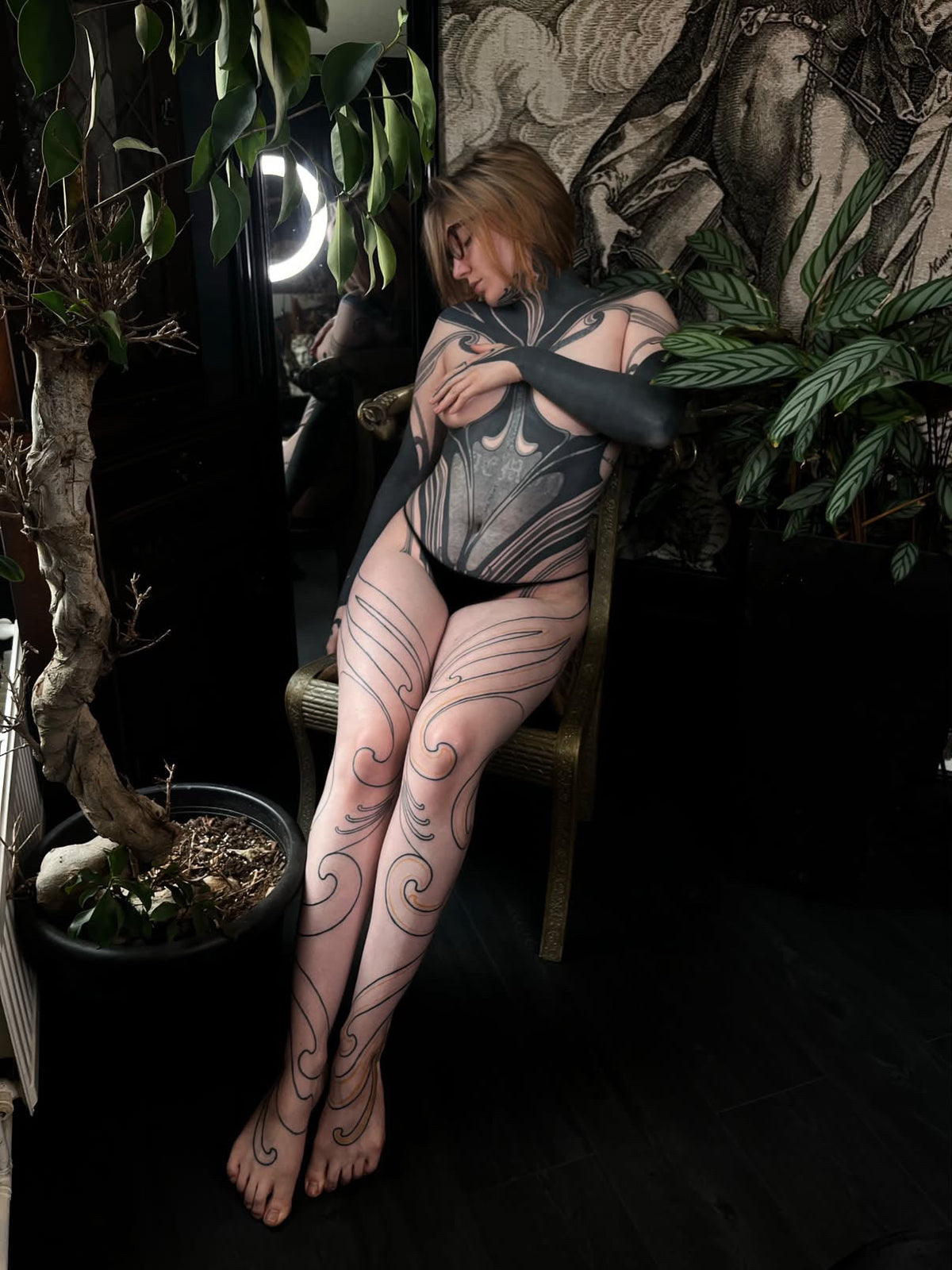
Sofiya Belousova’s path to tattooing took her through fashion, interior architecture and design. In this interview, she discusses the personal meaning behind large-scale work, the relationships bui...
Based in Austria, Manuel Rogaschewski began tattooing in 2015 and opened his private studio in 2021. His work developed through experimentation with patterns, blackout and large-scale projects, inc...